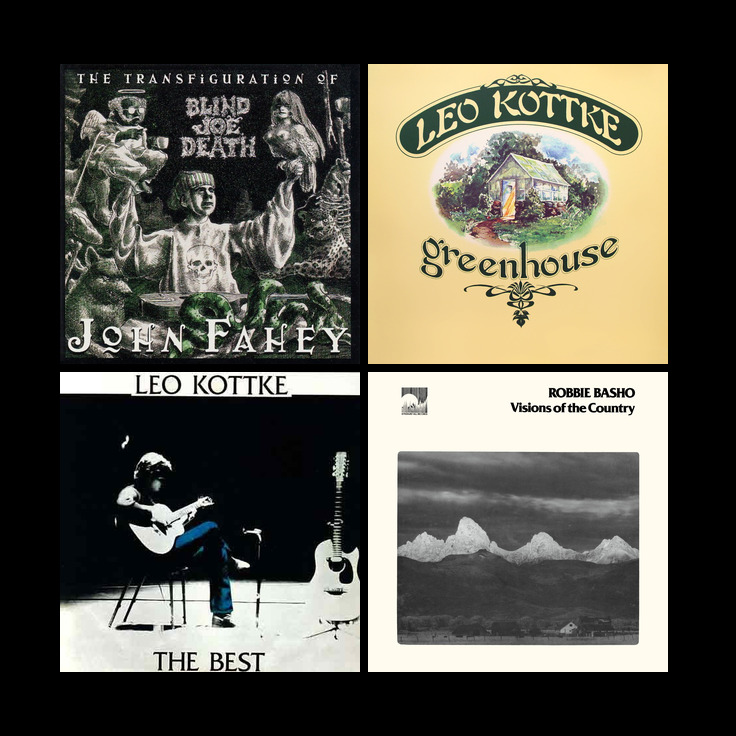
American primi-what now? I am no particular fan of the genre label „American primitivism“ – John Fahey reportedly coined the term to denote that his guitar playing was self-taught, vaguely alluding to artists like Henri Rousseau from the primitivism movement in the visual arts. But being untutored is not (all) primitivism denoted in its original context, diminishing the power of Fahey’s analogy. It leads to silly discussions about whether trained guitarists (who, notably, hung out with Fahey and learned their craft directly from the self-styled primitivist source, so to speak) really qualify. And I’ve seen people arguing that Fahey misunderstood his own self by daring to play complex, intricate things. And so on, the discourse is really quite something. Be that as it may, the Fahey-school did start from epigonal delta and piedmont blues, fusing it folk traditionals and his own idiosyncrasies regarding harmonies and song structure – leading to a strong and recognizable vein of progressive folk guitar that would fuse these foundational styles with progressive bluegrass, with psychedelia, with raga structures, with new age – there was no end to the amalgamations of steel-string-guitar thought of as a quasi-orchestral solo instrument. Amazing stuff. Today start with what I, as of now, think of as Fahey’s most coherent album of short forms, the amazing The Transfiguration of Blind Joe Death (1965), a fantastic blend of folk and blues tropes bent to his whims. We go on to a record I found in my father’s vinyl collection, 1972’s Greenhouse by Leo Kottke – great in technical terms, but low on intrigue. Kottke’s The Best is a very cool compilation from 1976, divided into four parts: Acoustic, Electric, Live, Singing. It was my first contact with this sort of progressive folk, incorporating anything from bluegrass to psych-rock, covering a lot of ground. Cool. We end with Robbie Basho’s Visions of the Country (1978) – new age and raga seen through American fingerpicking by a sort of Tom-Bombadil-character isn’t quite my thing, but it’s one of the most highly acclaimed albums in the style. Well, there we go.
Long forgotten, stubborn rituals
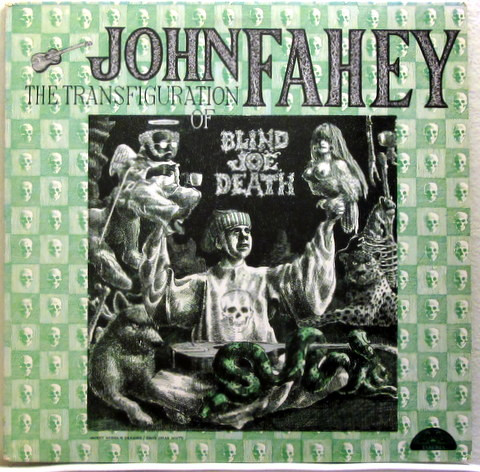
John Fahey: The Transfiguration of Blind Joe Death (1965): Genre Classic, 9/10
Small, obstinate tunes carved into sharp, crystalline folk forms – I don’t know which album should serve as an entry point to Fahey’s various recordings, but why not this one? It finds him exploring miniature formats, as opposed to long-winded ones, intricately arranged and translated into a fingerpicking guitar language that is weird and wildflowery, yet seem to follow some long forgotten, stubborn rituals.
The basis is folk and blues – simple forms. But the idiom isn’t. There is no way to classify this as neo-classicism or even avant-garde, sonically or formally, but it is far removed from the roots it takes as working material. It’s really hard to pin-point what it is – besides the virtuosity and the weird tunings, these are just the mechanisms. It’s the blues being played in the spirit of a Japanese stone garden, but with wry humour.
Whatever it is, it is one thing: Crisp and beautiful. Soothing, with a surprise around every crooked lick, every corner. Fahey can be almost stark on this record – but when he digs into the melody, when he really pushes a folk blues drone, like on “I Am the Resurrection”, it is unique and hypnotizing. Generally, the album taught me something straight-forward: It might not be your thing, but if you hear it, Fahey’s odd playing is everything his devotees tell you it is.
Feeling like an eagle losing motion
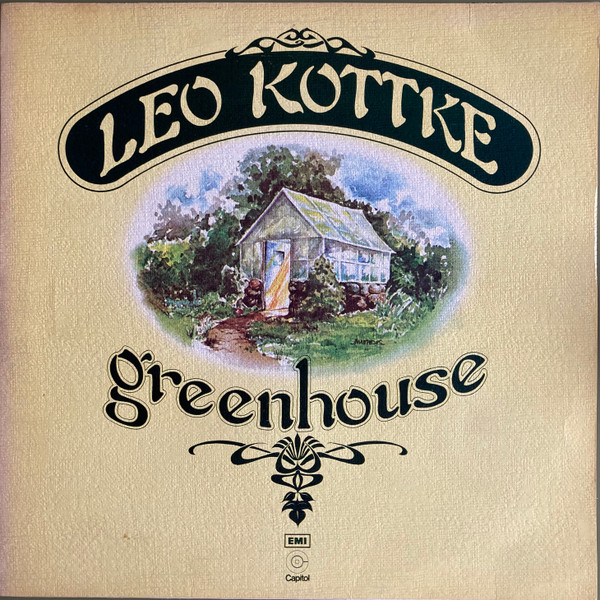
Leo Kottke: Greenhouse (1972): Fan Recommendation, 6/10
A folk guitar solo album on classcial levels of articulacy – whether Kottke speeds through bluegrassy fingerpicking festivals like the opener “Bean Time” or shifts to slower, bluesier tempi on numbers inspired or even written by John Fahey (“The Song of the Swamp” and “In Christ”, respectively), the clarity and complexity of his fretwork are always stated as such: There’s a certain gravitas to how Kottke presents what is at its core folk tunes. The sound is always wonderful, ringing strings and well-rounded songs, like ripe apples and fresh water sprouting from a fountain. Besides the bluegrass and American primitivism à la Fahey, there is a certain singer-songwriter touch placing the album firmly in its time – Kottke’s vocals are never more than alright, he knows it, the audience knows it, they really don’t make or break the songs like the wistful “Tiny Islands” or the slightly wearier “From the Cradle to the Grave”. It is notable that the lyrics articulate subject matters of feeling lost and disoriented in a very literal sense – the album’s vibrantly comfortable, competent appeal discloses its slight dip in creativity – Kottke doesn’t quite know what to do if there are no technical challenges left for him on folk guitar.
Do you have any preference?
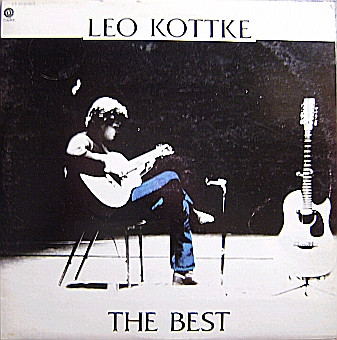
Leo Kottke: The Best (1976): Recommended Collection, 8/10
Kottke’s focused, innovative approach to folk floats somewhere between Western classical trained guitar and the reinvention of folk as the occult pseudo-primitivism of John Fahey, between progressive bluegrass and some jolly old singer-songwriter aspects. His piedmont-blues- and Appalachian-banjo-inspired fingerpicking is lightning fast and, from a technical point of view, almost incomprehensibly complex. He plays difficult bass lines and at the same times fingerpicks melodies with incredible prowess, adding a rhythm strumming somehow. A friend once told me that Kottke would play songs backwards in live settings, note-for-note, – just to show he could.
This technical virtuosity isn’t quite where the story ends with Kottke. He developed a soft spot for slightly psychedelic elements like the synths on „When Shrimps Learn to Whistle“ or the quite intricate guitar layers (no effects though) on the excellent cover of „Eight Miles High“ – he also heavily flirted with rock percussion quite a lot, settling into a steady folk or country rock groove on some tracks here. Throw in some straight Bach-quotes and you find yourself deep in progressive bluegrass and folk.
This collection is an early retrospective of his Columbia-career up to this point, drawing from six albums from 1971 to 1975, starting with his fourth album (his first three weren’t on Columbia). It gives you a very neat overview over his early 1970s output which found him maturing into a distinct artist identity, growing away from being the new hotshot folk picker. It’s the kind of compilation that might or might not be perfect for you: If you want to get only so much Kottke, this is the way to go. If this sets your interest on fire, you’ll assemble the albums faster than the 27-songs-running time of this thing. In both cases, The Best served you well.
Follow the milky way… home
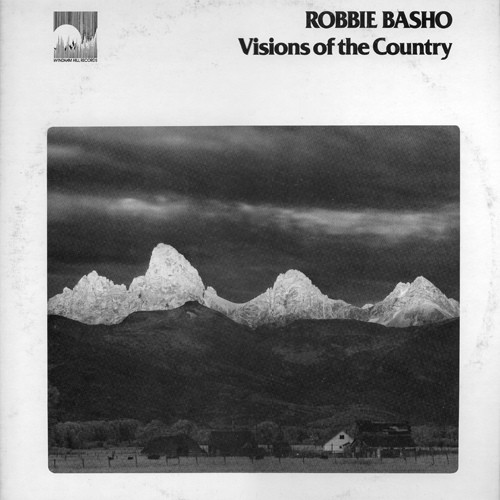
Robbie Basho: Visions of the Country (1978): Genre Classic, 6/10
When trying to imagine an ideal audience for Basho’s mystical and mystified fingerpicking guitar work and his undulating, mannerist vocals, I fail to come up with anything but a field of grain – and every spike of wheat is intently listening, bending its little tufts toward the oblivious quasi-priest preaching to himself, or the wind. The new age demeanor of this particular brand of American primitivism guitar is somewhat flabbergasting – but his highly advanced fingerpicking skills trying to marry American folk to classical raga structures is intriguing. The pristinely articulated steel guitar, cleanly cutting over the grassland, forms an interesting contrast to his vibrato-laden, somewhat contourless voice – and the self-centered delivery, as if speaking to only himself, is an aesthetic gamble as the piano-supported piece “Orphan’s Lament” shows. It’s certainly an approach that doesn’t concern itself with a supposed audience, which I assume is the album’s appeal among fans, having gone from a commercial failure to one of the most acclaimed albums of progressive folk music.
 Text Lambrecht
Anyone who calls his guitar a „box“ does not understand. Anyone who calls his guitar an „axe“ cannot play it very well. – John Fahey
LikeGefällt 1 Person