
The first song I’ve heard by Captain Beefheart was “Gimme Dat Harp Boy” on some blues compilation. It didn’t make an immediate impact. Having been told about Beefheart’s supposed avant-garde leanings, I found it, well, too conventional. I didn’t pick up Beefheart for years after, but the song stuck around, the muffled sound did something to me. Anyhow, years later and after a steadily increasing obsession with his output, let’s take a look at his early years, when psychedelic blues rock jams were all the rage.
I may be hungry, but I sure ain’t weird
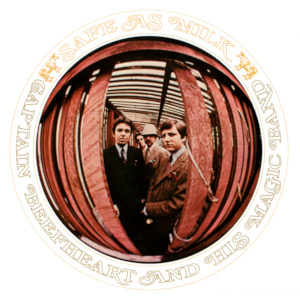
Safe as Milk (1967): Classic, 10/10.
Captain Beefheart takes the swampiest aspects of blues, the fun and energy of garage rock and a whole mouthful of hooks to come up with one of the freshest and enduring pieces of blues, rock and/or psychedelia. Starting with a mudslide-slinging blues riff on the opening track (Ry Cooder’s on guitar), Beefheart takes you for a ride careening through danceable weirdo-rhythm&blues („Zig Zag Wanderer“), ominous slo-mo garage romps („Dropout Boogie“), mangled doo-wop („I’m Glad“) and jaded, mischievous bubblegum blues („Yellowbrick Road“).
The album gives off a spirit as if Beefheart thought country blues was part of the Cubist movement, rootsy and far-out at the same time. You know all these riffs, but you hadn’t heard them played like this before – or ever since. Take the theremin (?) on the stomping buzz of „Electricity“, or the odd jungle groove of „Abba Zaba“, listen to that fat hook with that fat break with that fat blues-harp on „Plastic Factory” – it’s all so immediate and captivating. A top top top album, John Lennon was a fan, I’m a fan, you’ll be one if you have the slightest interest in blues and rock&roll past their fermentation date. Look out for the re-issue with several essential bonus tracks, for example the title track.

Automatic Sam told Ever-Ready Betty told Prestcold Milly
The Mirror Man Sessions (1967, 1971, 1999): Genre Classic, 10/10.
The Mirror Man sessions represent a definitive pinnacle of what psychedelic blues jams could be. Lengthy, ramshackle tracks based on Son House- and Howlin‘ Wolf-blues grooves with lumbering slide guitars, lumpy rhythms, delta blues harp and an atonal “shehnai” (think a wooden Indian soprano sax) swooning in and out of the mix. The side-long opener “Tarotplane” is blues trope after blues trope projected into the void of time, “25th Century Quaker” has a downright funky bounce, with its thumping, morassic bass line and restless, drifting riffs lending it all a slow pull. And the sweeping “Trust Us” (its best version here) is somewhat unfathomable, blues used for the purposes of druidic mysticism.
Recorded in 1967 in close contiguity to the Safe as Milk–sessions (you’ll note overlapping song material), Mirror Man was first released in 1971 as his fifth album, containing only the first four songs of this expanded issue. This version, adding four more tracks, is the essential one as it is much closer to double-LP-project called It Comes to You in a Plain Brown Wrapper which was supposed to be Beefheart’s second album. His actual second album, 1968’s Strictly Personal features re-recorded versions of the same song pool, who then were heavily tempered with for assumed commercial appeal. These original Mirror Man-tracks are the unedited 1967-recordings, and the result is more powerful, more “psychedelic”: no overly spaced out gimmicks, no self-important panning, no discombombulated post-production. I enjoy Strictly Personal for the very good album that it is beneath its over-produced surface, but the true, raw and weird marriage in blues of swamp and cosmos is right here.

Ah feel like Ah said
Strictly Personal (1968): Genre Recommendation, 8/10.
Ok, short edition recap: After Safe as Milk (1967), the Captain wanted to go full kozmo-blues and intended a double album called It Comes to You in a Plain Brown Wrapper, with the 1967-material that was partly issued in 1971 as Mirror Man and later more comprehensively reconstructed on 1999’s The Mirror Man Sessions. Weird as the debut album might have been, it was in touch with already established forms of fusing rhythm&blues, rock and psychedelia. But the Brown Wrapper recordings were lengthy 15 to 30 minute porch jams drawing from the most extreme sides of delta blues on the one hand and acid rock on the other hand – without using any psychedelic gimmickry, just delta blues rock stretched to its outer limits. Needless to say, no label would publish this at the time.
This is where the Strictly Personal story starts: Producer Bob Krasnow looked at the material, apparently made the band record shorter versions and tinkered with the usual psychedelia-clichés to align it with Hendrix or the 13th Floor Elevators – you know, acceptably (in a counterculture sense) „far out“ stuff. What we ended up with on Beefheart’s second official album are experimental blues compositions with a lot (but not too much) of psychedelic phasing, unfocussed song structures somewhere between tight r&b and rural bluesy jamming – and it is all so audibly manipulated in post-production that Krasnow got a lot of flak for it (critics included Beefheart himself). And, as history continued to show, Beefheart was always worst when someone tried to make him more appealing to the masses.
But you know what? It’s a good album. Were this the only album by the captain after his debut, my guess is we’d be happy to praise it. Sure, the Mirror Man recordings are ultimately better because they are not tinkered with and they are extreme in their approach. But this is a fun psych-blues rock album with most of Beefheart’s idiosyncrasies intact. The songs are really good and bouncy anyway, they’re just recorded and arranged differently here: Thumping space blues rock, intricate little experimental guitar sequences, straight Son House-delta jams. Thumbs up.
As it stands, it is a necessary addition for the fan, while only the bonus tracks on Safe as Milk and the Mirror Man Sessions (these two CDs basically make up the Brown Wrapper-takes) push it out of the spotlight.
 Text Lambrecht
Immer wieder eindrucksvoll: Captain Beefheart alias Don Van Vliet.
LikeGefällt 2 Personen