Tags:
- Album Reviews: Captain Beefheart’s specific brand of psychedelic blues rock (1967/68)
- Album Reviews: Macrodosing blues explorer Taj Mahal, major and minor appearances
- Various Artists: The Big Lebowski [Original Soundtrack]
- Captain Beefheart: Grow Fins: Rarities (1965–1982)
Album Reviews:
1967: Safe as Milk
1968: Strictly Personal
1971: Mirror Man [1967; 1999: The Mirror Man Sessions]
Compilation Reviews:
1999: Grow Fins: Rarities (1965–1982) (1965–1982)
2002: Magnetic Hands. Live in the UK 72–80 (1972–1980)
Safe as Milk
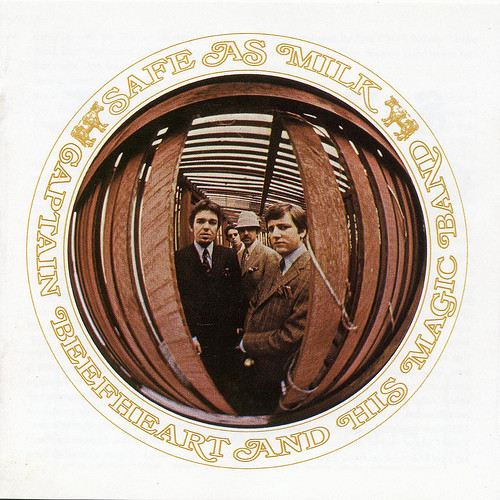
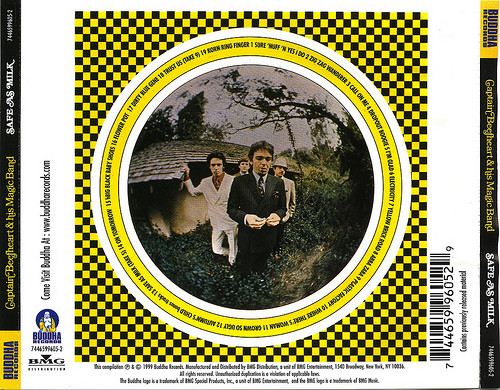
Album: Classic, 10/10 | Released: 1967 | Specific Genre: Psychedelic Blues Rock | Main Genre: Blues Rock, Psychedelic Rock | Undertones: Delta Blues, Rhythm&Blues, Chicago Blues, Doo-Wop, Experimental Rock | Label: Buddah Records
I may be hungry, but I sure ain’t weird
Captain Beefheart takes the swampiest aspects of blues, the fun and energy of garage rock and a whole mouthful of hooks to come up with one of the freshest and enduring pieces of blues, rock and/or psychedelia. Starting with a mudslide-slinging blues riff on the opening track (Ry Cooder’s on guitar), Beefheart takes you for a ride careening through danceable weirdo-rhythm&blues („Zig Zag Wanderer“), ominous slo-mo garage romps („Dropout Boogie“), mangled doo-wop („I’m Glad“) and jaded, mischievous bubblegum blues („Yellowbrick Road“).
The album gives off a spirit as if Beefheart thought country blues was part of the Cubist movement, rootsy and far-out at the same time. You know all these riffs, but you hadn’t heard them played like this before – or ever since. Take the theremin (?) on the stomping buzz of „Electricity“, or the odd jungle groove of „Abba Zaba“, listen to that fat hook with that fat break with that fat blues-harp on „Plastic Factory” – it’s all so immediate and captivating. A top top top album, John Lennon was a fan, I’m a fan, you’ll be one if you have the slightest interest in blues and rock&roll past their fermentation date. Look out for the re-issue with several essential bonus tracks, for example the title track.
Strictly Personal

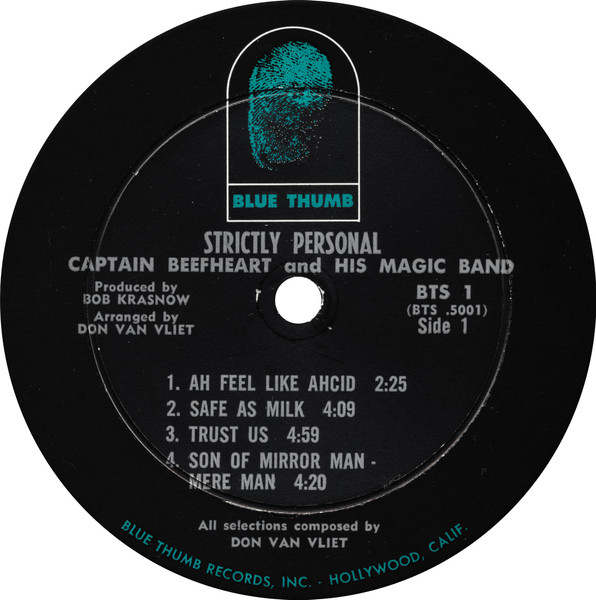

Album: Genre Recommendation, 8/10 | Released: 1968 | Specific Genre: Psychedelic Blues Rock | Main Genre: Blues Rock, Psychedelic Rock | Undertones: Delta Blues, Chicago Blues | Label: Blue Thumb
Ah feel like Ah said
Ok, short edition recap: After Safe as Milk (1967), the Captain wanted to go full kozmo-blues and intended a double album called It Comes to You in a Plain Brown Wrapper, with the 1967-material that was partly issued in 1971 as Mirror Man and later more comprehensively reconstructed on 1999’s The Mirror Man Sessions. Weird as the debut album might have been, it was in touch with already established forms of fusing rhythm&blues, rock and psychedelia. But the Brown Wrapper recordings were lengthy 15 to 30 minute porch jams drawing from the most extreme sides of delta blues on the one hand and acid rock on the other hand – without using any psychedelic gimmickry, just delta blues rock stretched to its outer limits. Needless to say, no label would publish this at the time.
This is where the Strictly Personal story starts: Producer Bob Krasnow looked at the material, apparently made the band record shorter versions and tinkered with the usual psychedelia-clichés to align it with Hendrix or the 13th Floor Elevators – you know, acceptably (in a counterculture sense) „far out“ stuff. What we ended up with on Beefheart’s second official album are experimental blues compositions with a lot (but not too much) of psychedelic phasing, unfocussed song structures somewhere between tight r&b and rural bluesy jamming – and it is all so audibly manipulated in post-production that Krasnow got a lot of flak for it (critics included Beefheart himself). And, as history continued to show, Beefheart was always worst when someone tried to make him more appealing to the masses.
But you know what? It’s a good album. Were this the only album by the captain after his debut, my guess is we’d be happy to praise it. Sure, the Mirror Man recordings are ultimately better because they are not tinkered with and they are extreme in their approach. But this is a fun psychedelic blues rock album with most of Beefheart’s idiosyncrasies intact. The songs are really, really good, they’re just recorded and arranged differently here: Thumping space blues rock, intricate little experimental guitar sequences, straight Son House-delta jams. Thumbs up.
As it stands, it is a very necessary addition for the fan, while only the bonus tracks on Safe as Milk and the Mirror Man Sessions (these two CDs basically make up the Brown Wrapper-takes) push it out of the spotlight.
Mirror Man / The Mirror Man Sessions
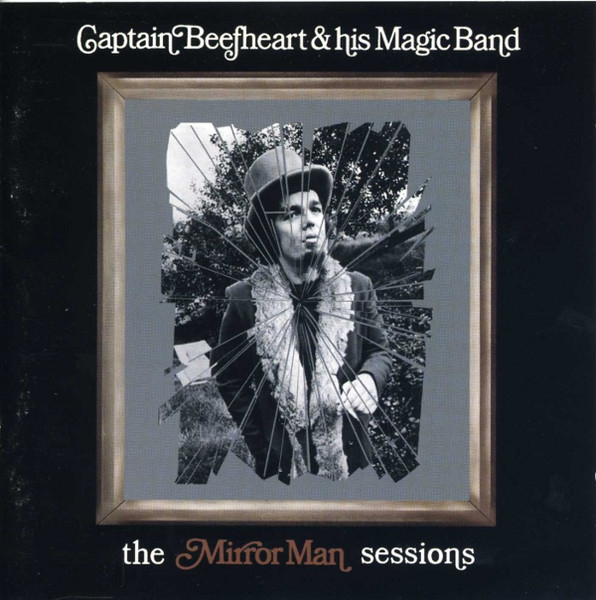
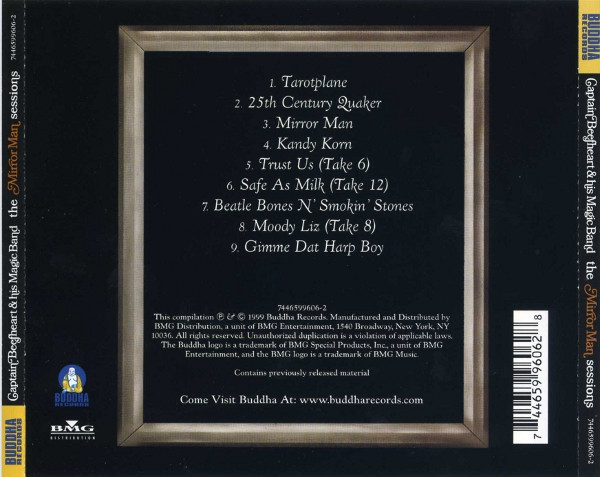
Album: Genre Classic, 10/10 | Released: 1971/1999 | Recorded: 1967 | Specific Genre: Psychedelic Blues Rock | Main Genre: Blues Rock, Psychedelic Rock | Undertones: Delta Blues | Label: Buddha Records
Automatic Sam told Ever-Ready Betty told Prestcold Milly
The Mirror Man sessions represent a definitive pinnacle of what psychedelic blues jams could be. Lengthy, ramshackle tracks based on Son House- and Howlin‘ Wolf-blues grooves with lumbering slide guitars, lumpy rhythms, delta blues harp and an atonal “shehnai” (think a wooden Indian soprano sax) swooning in and out of the mix. The side-long opener “Tarotplane” is blues trope after blues trope projected into the void of time, “25th Century Quaker” has a downright funky bounce, with its thumping, morassic bass line and restless, drifting riffs lending it all a slow pull. And the sweeping “Trust Us” (its best version here) is somewhat unfathomable, blues used for the purposes of druidic mysticism.
Recorded in 1967 in close contiguity to the Safe as Milk–sessions (you’ll note overlapping song material), Mirror Man was first released in 1971 as his fifth album, containing only the first four songs of this expanded issue. This version, adding five more tracks, is the essential one as it is much closer to double-LP-project called It Comes to You in a Plain Brown Wrapper which was supposed to be Beefheart’s second album. His actual second album, 1968’s Strictly Personal features re-recorded versions of the same song pool, who then were heavily tempered with for assumed commercial appeal. These original Mirror Man-tracks are the unedited 1967-recordings, and the result is more powerful, more “psychedelic”: no overly spaced out gimmicks, no self-important panning, no discombombulated post-production. I enjoy Strictly Personal for the very good album that it is beneath its over-produced surface, but the true, raw and weird marriage in blues of swamp and cosmos is right here.
Grow Fins: Rarities (1965–1982)
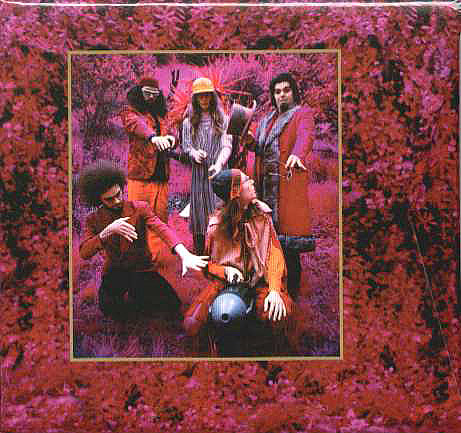
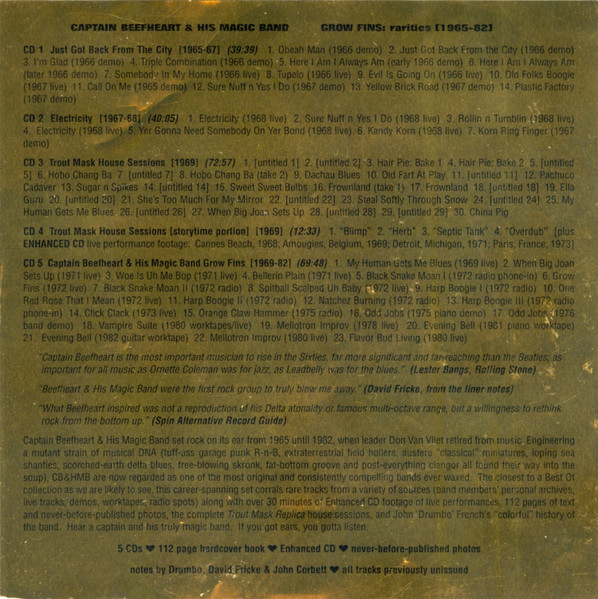
Archival / Box Set: Fan Recommendation, 8/10 | Released: 1999 | Recorded: 1965–1982 | Specific Genre: Experimental Rock, Psychedelic Rock, Blues Rock | Main Genre: Rock, Psychedelia | Undertones: Experimental, Field Recordings | Label: Revenant
I should dip myself into that coca-cola
This box set is subject to the box set-curse more than any other I’m aware of. There are musical pearls next to bits recorded from the back of the studio (minutes of mumbling, chair clicking, airplane noises from outside the window), there’s historically indispensable stuff next to, well, just stuff. Also, it manages to seem expansive and inomplete all at the same time: There is so much previously unreleased material here that it doesn’t really leave you asking for even more Trout Mask outtakes or even more radio snippets. But then, this hardly fulfills any criteria of a ‚historically comprehensive‘ box set: It’s just a huge ragbag of anything that could be interesting to the fanatic followers of Beefheart. These, though, will be delighted, because in a sense, this doesn’t plays as a box set but, more fitting, like very precise representation of Beefheart’s career: Full of bursts of energy and brilliance, full of holes and frustration – but extremely rewarding for those that listen closely.
This mostly doesn’t make for a coherent listening experience – but just mostly. The five CDs thankfully all follow an at least chronological coherence. This redeems some drawbacks in the sequencing per CD. The true problem is: To issue any of this stuff only makes sense within a larger context. There is no way they could have split the „good stuff“ from the scraps, you have to take in the whole sludged affair or just avoid it.
The first CD is a bunch of early blues rock numbers that never made it on an album (and some that did). The sound is similar to Safe as Milk, and since these are all complete demos or live cuts, you can actually listen through the whole thing with excitement. It’s a primal, terrific version in that rousing mid-1960s style between R&B, psychedelia and deep blues. For Beefheart fans, this first CD is inexpendable. The band is already in full flight, Beefheart is already all there. The sound quality is mostly murky (but the swampy approach lets you accept that), and the band’s playing is basic but they rock hard and fierce. Given that the early cuts are from 1966, this must have been one of the heavier bands at the time – raw, ramshackle. This CD also satisfies the box set-buyer in all respects: You get cuts of later album tracks („Call on Me“, „Yellow Brick Road“), which are inferior to the later album tracks, but interesting from an evolutionary perspective. You get awesomely grooving rhythm/blues/rock numbers that are every bit as good as the ones on Safe as Milk („Here I Am I Always Am“, „Obeah Man“). And finally, you get Beefheart performing numbers of his idols („Evil is Going On“, „Tupelo“, „Somebody in My Home“) – all absolutely terrific swamp blues in imposing John Lee Hooker- and Howlin’ Wolf-manner.
The second CD is in a similar vein, collecting live records from apparently European tours. Manic versions of standards like „Rollin’ n’ Tumblin’“ are here, as well as some Mirror Man-era pieces. Hard, driven, uncompromising blues rock. This is also listenable from beginning to end.
With the third CD, the promised box-set-problems start. The whole CD comprises evidently the leftovers they could find in the trashbin of the studio where Trout Mask Replica was recorded. You start of with fifteen minutes of documentary style noises which seem to stem from a recording device pickin up sounds while the band members were still preparing. Okay, you can skip this, so I don’t mind. The rest is purely instrumental versions of Trout Mask Replica. These are practice runs of the album tracks, there is no ‚evolutionary‘ aspect here. I must say that I like to listen to these compositions bare-boned, without Beefheart’s voice-beef, so to speak. You actually get a very direct approach to their immediate groove and compositional structure. And for these like me which are at least as interested in his compositional skills as the vocals, this remains an interesting listen. So, while this is far too long as a CD (i mean, this basically is all of Trout Mask Replica without the vocals plus some additional scraps and tuning-up), I still am happy with this. For some, this probably is expendable. Why listen to the relatively unedited, non-vocalised version of Trout Mask Replica? Why should I listen to the band tuning up for minutes? I understand the questions. But hey, at least you get to witness how the conversation with the kids who just moved here from Reseda ended up on the album. The most obscure quasi-gem I could find on here is the untitled 29th track – before the band goes to record „China Pig“, you can hear a jam of the blues standard „Candy Man“ for about a minute. Why is this interesting? I don’t know. I just never knew that the Captain had done at least one minute of „Candy Man“ in his life.
Then, CD 4. Just forget the musical aspect: There isn’t any. It’s Beefheart talking, some noises, Beefheart joking about Herb Alpert, and that’s it. 12 minutes of unedited documentary studio babble (incomprehensible for the most part). Don’t get upset though, in the original package, this is actually a VCD. With moving pictures. So, no reason to listen to this on your CD-player. But you do get to see video clips, comprising live versions of songs (2 from Safe as Milk, 3 from Trout Mask Replica, 2 from [Album1350710, Lick My Decals Off, Baby] and „Click Clack“ from [Album8100, The Spotlight Kid], taken between 1968 and 1973). These are great, the live setting showcasing how musical everybody involved with Beefheart was. You can watch these on Youtube nowadays, of course.
Finally, the 5th CD. This is the most imbalanced piece of the whole affair, I guess because they just threw anything on there from his post-Trout Mask Replica period they couldn’t fit anywhere else (with a time span of 1969–1982). So, in no particular, haphazard order, you get a lot of live recordings (nothing exceptional), Beefheart performing short pieces of blues harp and acapella blues on the radio (terrible quality, but cool stuff), some more live recordings which border on performance art or futurism „sound machines“ and were not actually meant for the CD-format, I presume („Spitball Scalped Uh Baby“), and some weird demos for more complex avant-pieces.
And buried in the middle of this looong CD, you get the most stunning record of the whole box set, which is the Captain performing „Orange Claw Hammer“ with Frank Zappa on acoustic guitar for the radio. Zappa’s simple strumming fleshes out that this song follows the actual structure of a sea shanty (which could only be guessed at with the acapella version on Trout Mask Replica), but that’s good, because now we have both: an avant-garde acapella version of a surrealistic sea shanty and a beautiful acoustic guitar version of that same sea shanty. Then the mixed bag continues, many experimental live recordings, Beefheart messing with a mellotron in Sun Ra-manner – with the result that you realise Sun Ra actually could play the instrument. Some of these are improv-sketches, frustrating Beefheart and audiences alike („Sun Ra!“ someone keeps shouting on „Melltron Improv (Live ’80)“, causing Beefheart to yell at the crowd, violently batter the keys and ask „Who was that, Liberace?“). Some others, though, are quite interesting. I dig both the versions of „Odd Jobs“, while I admit that this is already hardcore Beefheart-ology. Nothing to convert people. The „Odd Jobs“-piano demo is strangely forlorn and beautiful – you find the most realised and best version of that lost piece on the reconstructed Bat Chain Puller album from 2012. Most of this CD, naturally, comes in just about bearable sound quality.
So. What we have here then is a box set which contains enough to make it essential for the fan – both from a historical (CD1 and CD5) and a musical (CD1 and CD5… and partly CD2 and even 3) perspective. Everyone else should stay well away from this. This is the last territory of Beefheart-land one should turn his attention to. If you’re the enthusiastic explorer in the old spirit, you’ll find plenty of adventure and condiment on this wild, wide, dangerous and tedious jungle continent.
Magnetic Hands. Live in the UK 72–80
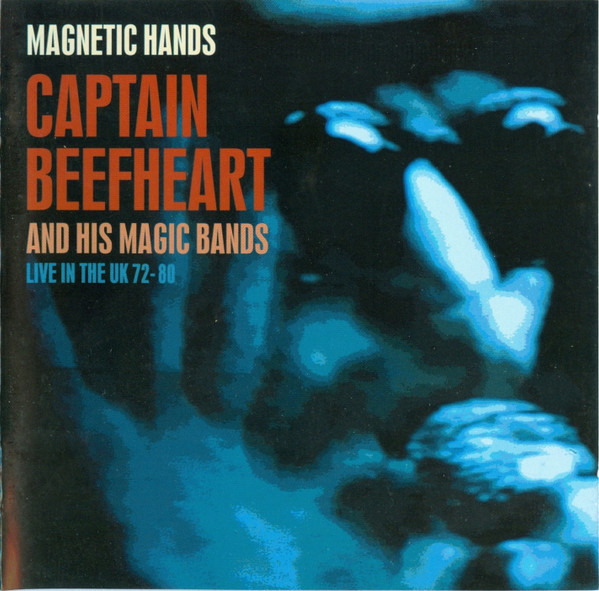
Live / Collection: Fan Recommendation, 7/10 | Released: 2002 | Recorded: 1972–1980 | Specific Genre: Experimental Rock, Blues Rock | Main Genre: Rock | Undertones: Blues, Psychedelic Rock, Avant-Prog | Label: Viper
You know I’m gonna do exactly what I want
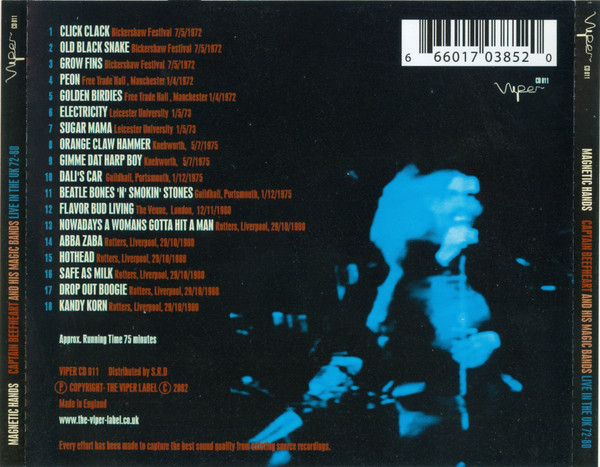
These are previously unavailable live cuts of Beefheart gone wild from seven shows between 1972 and 1980. While these are all tinny and unequalised bootleg recordings, through all the hissing and static, there’s enough left to let you hear these must have been truly magnetising performances.
There is no track here where the terrible sound quality truly ruins the aura for me – even the jurassic cackling of “Sugar Mama”, stomping along at eight minutes, is a bit like finding a dinosaur fossil: not the real living thing, but how cool is that skull? Besides the tracks that are relatively tolerable to the ear and well-performed (a fierce „Grow Fins“, „Nowadays a Woman’s Gotta Hit a Man“ and a deadpan „Drop Out Boogie“), there’s a mind-blowing definite instrumental (!) version of „Electricity“ – six ferocious minutes of pure blues-goes-prog fury delving into a riff section that wasn’t on the album cut and worth every cent of this whole CD. A huge bass, barb-wire guitar riffs and wild harp jamming.
While these are different incarnations of the Magic Band, you couldn’t really tell from their sound and repertoire: Abstract instrumentals, croaky interludes of blues shouting, hard hitting psych-rockers. There’s some entertaining stage banter, but mainly this is interesting because of its raw and unpolished quality. The lengthy primitive blues stomp of „Sugar Mama“ is interesting in this aspect as Beefheart wouldn’t do this particular thing on record after 1972 (or more precisely, after the Mirror Man sessions) anymore. Not that it is a great blues or any such thing, it’s just intriguing to hear how he gets the audience to clap along to the rhythm as all the instruments stop and he dives into a witch doctor blues persona, working his own voice like a synthesizer, squeeling, murmuring and chanting to an audibly mesmerized audience.
One note about the repertoire: The compilation shows us a programme of early 1970s material, with actually just one track dating from later than his 1972-albums (it’s „Hothead“), even though more than half of the tracks date from perfomances later than 1975. Now, given the fact that he took a forced break from releasing between 1974 to 1978, this isn’t really surprising. Still: Seven songs from a show late in 1980, meaning this is the Ice Cream For Crow band, and, except for „Hothead“, they basically play Safe As Milk . And: It’s all great! Even the sound quality for the 1980-show is quite decent. Anyhow, it is absolutely worth seeking out for fans, to get a picture of live-Beefheart during his lost mid-1970s period, to get some unholy blues shants, and to be blown awa by that “Electricity”-take.
Trivia: I don’t know if the two things are related, but the amazing (and definite) other live album available titled I’m Gonna Do What I Wanna Do might have taken its title from an incident here: After „Flavor Bud Living“, a guy from the audience calls out for „Glider“ (just pause a minute and imagine being at a Beefheart-concert. Is that what you’d request? No offense though, „Glider“ is great), to which the Captain replies: „You know I’m gonna do exactly what I want!“
Recording dates: Tracks 1-5 (1972); tracks 6-7 (1973); tracks 8-11 (1975); tracks 12-18 (1980).
 Text Lambrecht